Time Management ⏱️
How you manage your time says more about your effectiveness than how skilled you are technically. Most engineers never lack ability — they lack the discipline to protect their focus and the self-awareness to know when they're running on fumes.
Prioritize ruthlessly
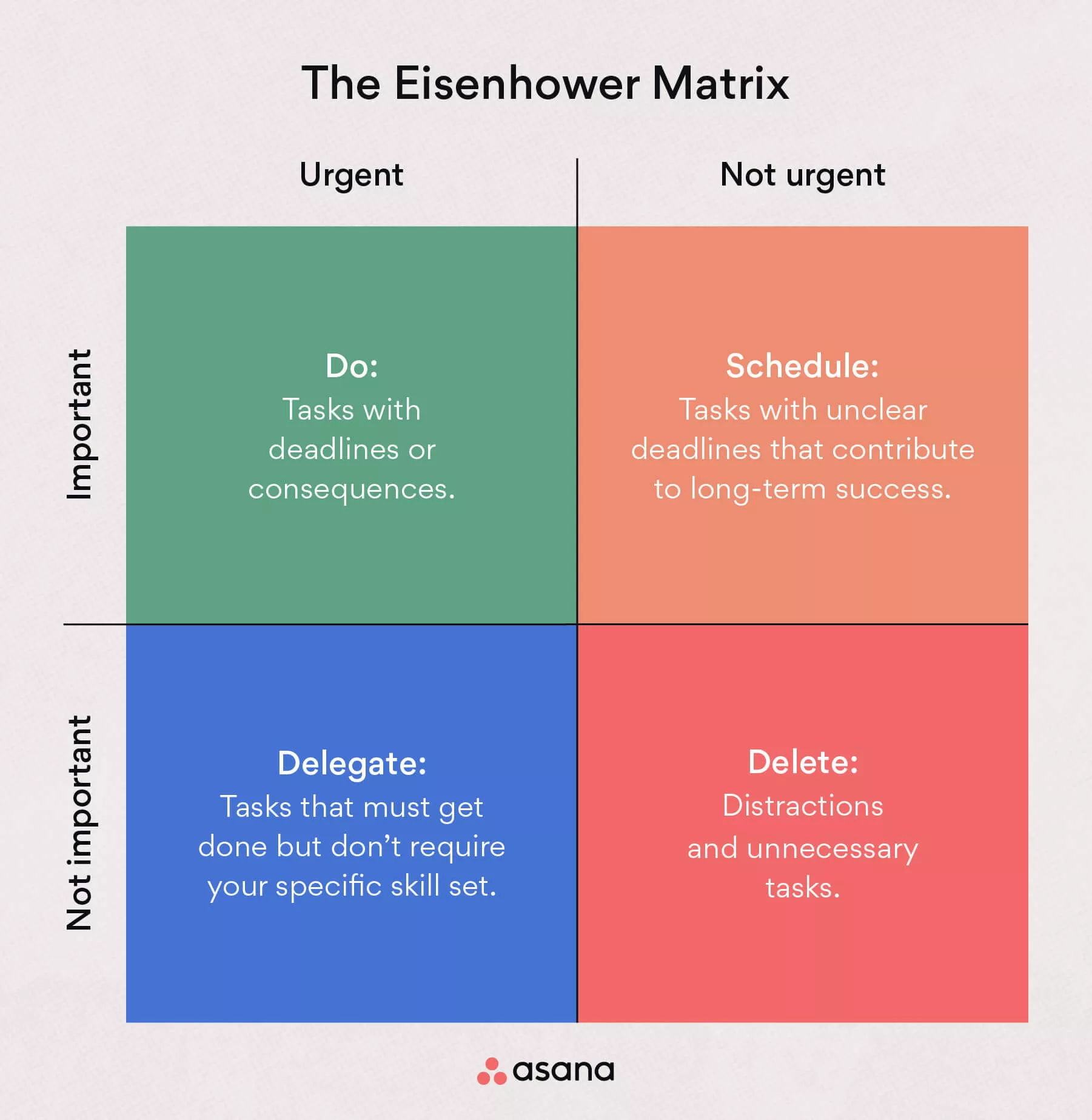
The Eisenhower matrix is simple but hard to follow honestly. The trap is that everything feels urgent when you're in the middle of it. A few things that help:
- Build buffers into your estimates. If you think a task takes 5 hours, estimate 7–8. Interruptions, context switches, and unknowns are not exceptions — they're the norm.
- Plan your day deliberately. Each morning or evening, review priorities, check if your estimates still hold, and plan the next day. Communicate early if you see drift — surprises erode trust faster than delays.
- Say no to protect your focus. Non-essential meetings and tasks will fill every gap you leave open. Protecting your planned work time is not selfish — it's how you deliver.
- Take breaks, but make them intentional. Short pauses help you stay sharp. Sometimes the best break is checking in on a coworker's topic — you recharge and stay connected at the same time.
Watch your limits
Be careful with ambition. Pushing hard feels productive, but it has a cost that compounds silently. The signs tend to show up in patterns:
- Emotional attachment — "I spent my nights on this, and we're canceling it?" When you over-invest, you stop evaluating the work objectively and start defending it personally.
- Mental fog — Unable to think straight after pouring everything into the previous feature. Forced to default to simple tasks for days. That's not recovery — that's debt.
- Irritability — Shorter fuse than usual, more aggressive in reviews or conversations. Almost always tied to tiredness and trying to achieve too much.
None of these make you a bad engineer. But recognizing them early saves you from the spiral.
Know yourself
- Identify your peak hours. Are you sharpest in the morning or late at night? Schedule your hardest work there. Everything else can fill the gaps.
- Pay attention to your environment. Silence, music, a busy café — what actually helps you focus versus what you think helps? Figure out your ideal setting and protect it.
- Know when to push and when to stop. Sometimes staying in the zone pays off. Other times, taking a break sets you up for a stronger next hour. The skill is reading which situation you're in — not defaulting to one approach.
- Review your patterns honestly. Do you procrastinate? Default to isolation over collaboration? Assume instead of asking? Once identified, half the work is done.
Tools
Find tools that enable your workflow — not the other way around. I gravitate towards note-taking tools that support markdown for portability, but the "best" tool is the one that actually matches how you think and work.
There is no silver bullet. Experiment, and don't be loyal to a tool that's slowing you down.